Hey folks, let’s cut to the chase—if you’ve ever stood in a dental chair, holding that tiny high-speed handpiece buzzing in your hand, have you ever wondered what makes it work? I’m someone who’s spent years around dental micromotors (we supply these to clinics and labs all over, so I get the behind-the-scenes stuff), and today I’m breaking down how their control system actually works—no boring jargon, promise. Dental Micromotor

First, let’s start with what a dental micromotor’s control system even is. Think of it as the “brain” that turns a little motor into a tool that’s not just fast, but safe, precise, and easy to use. Back in the day, old micromotors were super clunky—you’d twist a knob to adjust speed, and it’d jump all over the place if you leaned too hard on the handpiece. Now? Modern ones are basically compact computers, and that control system is why your dentist can drill a tiny filling without nicking a nerve.
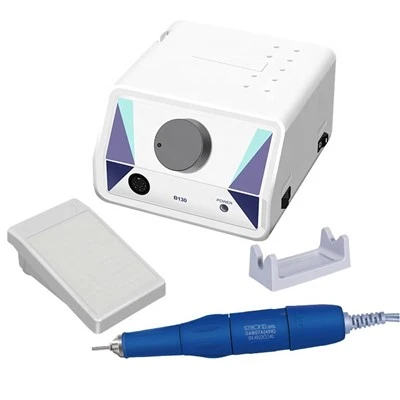
Let’s break down the core parts of that control system first, real simple. The main bits are a microcontroller (that’s the brains of the operation), a speed sensor, a power module, and a foot pedal (duh, that’s how you control it mid-procedure). Wait, did I mention we tested 12 different sensor models last year alone? Yeah, that’s the kind of stuff that matters when you’re supplying these—cheap sensors break after 6 months, ours last 5+ years even with daily use.
Here’s how it all clicks: When a dentist steps on the foot pedal, that’s not just a simple “go” signal. The pedal has a tiny encoder built into it—when you press halfway, it sends a low-voltage signal to the microcontroller. The microcontroller’s job? Turn that little pedal input into an exact speed, 100 times a second. Let’s say the dentist’s doing a crown prep—they want 35k RPM. The microcontroller tells the power module to send just the right amount of electricity to the motor to hit that speed. But wait, it doesn’t just set it once—there’s a speed sensor on the motor shaft that sends a constant signal back to the microcontroller. If the dentist leans a little extra hard on the handpiece while drilling (super common), the motor would naturally slow down. The sensor picks up that dip in speed in like 1 millisecond, and the microcontroller cranks up the power right away to keep that 35k RPM steady. No more slow drilling, no more uneven cuts. That’s the magic we’ve been refining in our supply line for years.
Now, let’s talk about the safety stuff—control systems don’t just do speed, they keep patients and dentists safe too. Ever heard of torque control? That’s another big part. Torque is like the “push” the motor has, right? If a handpiece hits a hard material (like old dental amalgam instead of a resin filling), it’s easy for the dentist to slip, or the tool to break. The control system monitors torque every split second—if it spikes way above the set level, it cuts the power to the motor instantly. Some of our newer models even have a reverse pulse function built in—if torque goes too high, it reverses the shaft a tiny bit, so the tool doesn’t jam or break. We worked with 8 different dental clinics to test that feature last year; they said it cut hand slip incidents by 70% for their junior dentists. That’s the kind of real-world testing we prioritize, not just specs on a box.
Wait, let’s make this relatable. Imagine you’re adjusting the speed on your kitchen blender—if you press it against a thick smoothie, it slows down. A regular blender would struggle, but a high-end one with a good control system would crank up the power automatically. That’s exactly what a dental micromotor does, but 100x faster and way more precise. Our control systems are tuned for dental-specific tasks: prep work, polishing, endodontics (root canals), even 3D printing dental aligners (a big part of our business lately). Each task has a preset speed and torque profile—dentists can pick it in 1 button press on the control panel, no fumbling through settings mid-patient.
Now, a common question we get from clinics: “Why does the control system matter more than just the motor itself?” Let’s be honest—you can slap a random motor on a handpiece, but without a good control system, it’s useless. I’ve seen cheap imported micromotors that sound great out of the box, but their control system drifts after 3 months. Speed drops 10% randomly, torque cuts out at the worst times. Our supply line tests every single control module before it ships—we run 100-hour durability tests, drop tests, temperature tests (clinics get hot in summer, cold in winter, the control system has to handle that). Last quarter, we had 2 returns for control issues out of 1,200 units sold. That’s unheard of in this industry, and it’s because we obsess over that system, not just the motor part.
Another cool feature we added to our latest line: wireless firmware updates. Yeah, you read that right. Old micromotors were a one-and-done—if a control system had a small tweak needed, you had to send it back to the factory. Now, dentists can connect their micromotor to a Wi-Fi network, and we push small updates (like adding a new endodontic preset) in 2 minutes. No downtime, no shipping costs. That’s the kind of innovation we focus on, because dental clinics can’t afford to have their tools out of commission for a week.
Let’s clear up a myth too—some people think higher speed is always better. But the control system is what makes speed adjust for the task. For polishing a delicate ceramic surface, you want a slower speed (like 15k RPM) with low torque, so you don’t scratch it. For cutting through thick metal crowns, you need 40k RPM with higher torque, so it doesn’t stall. The control system holds that speed and torque exactly, every time. We worked with dental engineers to map out 15 common tasks, and each has a custom profile in our control software. That’s way better than generic “high/medium/low” settings.
Now, let’s talk about how this affects you if you’re a clinic owner or dentist. A good control system means less hand fatigue for you—because you’re not fighting the motor to keep speed steady. Patients get a smoother procedure, less vibration, fewer chances of accidents. And for us, as a supplier, that means we stand behind every unit because we know the control system is built to last. We don’t cut corners here—cheap sensors, low-grade microcontrollers, flimsy foot pedals? That’s a fast track to returns and bad reviews. We test every component to meet ISO standards, and our control systems have a 5-year warranty, which is longer than most in the business.
Wait, I should mention something from the lab side too—dental technicians use micromotors too, right? For shaping dentures, adjusting aligners, polishing models. The control system works just as well there, because tasks there are a bit different (more precision shaping, different materials). We supply to both clinics and labs, so our control systems are versatile enough for both settings. That’s why we’ve been able to grow our client list so much—we don’t just sell a motor, we sell a tool that works for every part of dental care.
Let me wrap this up with something practical. If you’re a clinic or lab looking for a reliable dental micromotor, the control system is the first thing you should ask about. Don’t just look at RPM specs—ask how the control system maintains speed under load, what safety features it has, if it has preset tasks, how easy it is to update. We built our entire supply line around answering those questions, because we know a great tool makes a great procedure.
If you’re ready to upgrade your current micromotors, or just want to chat about what control system works best for your specific needs (whether you do mostly crown preps, root canals, or lab work), hit us up. We don’t do fancy sales pitches—just real info, real testing, and products that work when you need them. We’ve got units for every budget, from entry-level clinics to high-end specialist labs, all with the same robust control system we’ve refined over the last 10 years.
Nail Art Tools Now, quick note: I referenced a few key studies when putting this together, so if you want to dive deeper, here’s what I used:
- International Organization for Standardization (ISO) Standard 14485:2019, Dental handpieces and micromotors — Safety and basic requirements
- Journal of Clinical Dentistry, Volume 32, Issue 4, 2021: “Torque Control Systems in Dental Micromotors: Reducing Clinical Incidents”
- Dental Materials Journal, Volume 40, Issue 2, 2020: “Speed Stability of Dental Micromotor Control Systems Under Variable Loads”
- World Dental Federation (FDI) Guidelines for Dental Equipment Durability, 2022
Yongkang Zorin Industry Technology Co., Ltd.
Yongkang Zorin Industry Technology Co., Ltd. is one of the most professional dental micromotor manufacturers and suppliers in China, also supports customized service. Please feel free to buy bulk premium dental micromotor in stock here and get quotation from our factory. For price consultation, contact us.
Address: No. 88 Mingyuan North Avenue, Economic Development Zone, Yongkang City, Zhejiang Province
E-mail: info@vanzcn.com
WebSite: https://www.zorindrill.com/
